
To have a choice and secure my academic career
ESTIA's three-year Bachelor's degree in engineering trains engineers who are directly operational in innovative sectors such as industry 4.0, artificial intelligence and renewable energies. A professionally-oriented course with work placements and practical projects, ideal for those who want to enter the world of work quickly
Profile
Eligible candidates for the Engineering School Bachelor's degree
ESTIA's Bachelor's in Engineering is reserved for technological baccalaureate holders and baccalaureate holders with a scientific specialisation.
- TECHNOLOGICAL BACCALAUREATE: STI2D AND STL
- GENERAL BACCALAUREATE for students who have chosen the following options:
Mathematics + 1 scientific EDS of your choice: Physics-Chemistry, SVT, NSI, SI, Bio-ecology Or Mathematics + 1 non-scientific EDS
Teaching the bachelor's degree in science and engineering
Programme and teaching methods :
ESTIA's Bachelor's in Engineering is based on an innovative, professionalising teaching method in which the learner becomes an active participant in his or her training. The curriculum alternates theoretical training sessions with project activities, technical achievements and exposure to the professional environment. Through specific training modules, Bachelor students are made aware of and trained in the following themes.
The training is based on 4 fundamentals
AN INNOVATIVE, ACTIVE & INTUITIVE APPROACH TO TEACHING: As close as possible to the company: students learn by doing and by using the real tools of the industrial expert. The training process is punctuated by periods spent in companies, numerous technological projects and time spent in our fablabs.
INTERNATIONALISED TRAINING: In addition to the many hours devoted to practising English and Spanish, the students spend a month together at a Spanish university, where they follow technical training courses.
some students may spend part of their third year at an American university (Los Angeles) or at a foreign university (Latin America, Asia, Africa or Europe).
ALTERNATE TRAINING BETWEEN THE COMPANY AND THE SCHOOL: the 3rd year of training can be completed as an employee; students spend 75% of their time in the company, where they complete their training.
A QUALIFYING AND SPECIALISED TRAINING PROGRAM, 3 SPECIALISATIONS ARE OFFERED: Industrial Engineering & Mechatronics, Industrial Design and Digital Engineering.
Objectives for the 3 years :
1st year: learning and practising
ACQUIRE THE BASICS of technology and mathematics.
UNDERSTAND THE COMPONENTS of business (economics, structure, communication).
WORK IN GROUPS on projects using appropriate methods.
8-week work placement (minimum): Discover a professional environment.
2nd year: DEVELOPING & INTERNATIONALISING
KNOW HOW TO USE YOUR KNOWLEDGE to acquire new skills in mechatronic systems.
KNOW HOW TO DESIGN AND MANUFACTURE technological systems according to specifications. (With the implementation of a project throughout the year).
STRENGTHEN YOUR LANGUAGE SKILLS and acquire new knowledge in a foreign university (minimum 1 month).
INTERNSHIP 8 weeks (minimum) Discovery of a professional environment.
3rd year: MASTER & PROFESSIONALISE
SPECIALISED EDUCATION (Robotics, Structural Mechanics).
THEMATIC REINFORCEMENT (Turbomachinery, mobile robotics, entrepreneurship, etc.).
All students have at least 4 weeks' international experience. It is also possible to study abroad for 1 semester in 3rd year.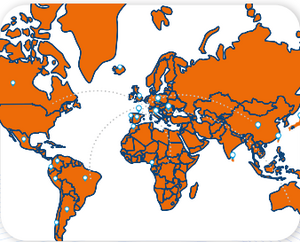
20-week (paid) INTERNSHIP + End-of-studies assignment leading to the writing of a Bachelor's dissertation
or PROFESSIONALISATION CONTRACT 75% in a company + End-of-studies assignment leading to the writing of a Bachelor's dissertation
Technology projects :
The projects (PFR) are multidisciplinary, team-based projects that take place over the three years of the Bachelor cycle. They enable direct application of all the concepts taught during the course and put learners in a real-life situation as part of a professional project.
Each semester, students have access to training sessions on the technological platforms of the ESTIA ecosystem. During all phases, they are monitored and tutored to prototype, test and model all or part of the solutions. Depending on their needs, students choose the tools they need to achieve their objectives.
Estia introduces you to advanced fields
- Prototyping and digital design
- Composite materials manufacturing
- Robotisation of industrial processes
- Production and storage of electrical energy
- Energy recovery
Specific courses
- Modules specific to the industry of the future
- Management of technology and entrepreneurship
- Mobile and humanoid robotics
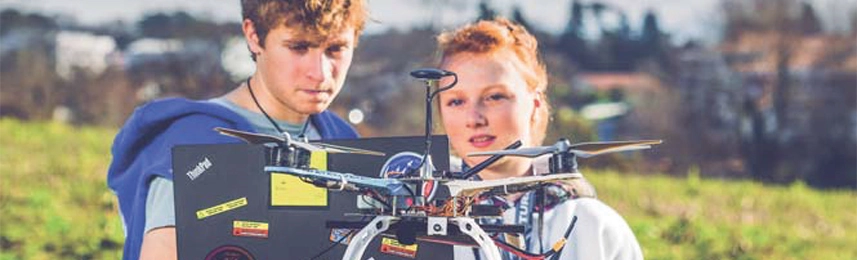
- Embedded systems (drones)
- Turbomachinery and motorisation
Being trilingual
Students will have 8 hours a week of practical practice in English and Spanish. In addition, several technological courses are taught in English and Spanish. The aim is to enable students to achieve a B2 level in English and Spanish by the end of the course.
The project is based on demonstrators, thanks to ESTIA's technical platforms
Part of the training is built around demonstrators and industrial solutions. On the platforms, learners rub shoulders with a mixed audience: continuing education practitioners, researchers, R&D engineers and young learners.
> COMPOSITADOUR :
Use of composite materials: automation and robotisation
> PEPSS :
Virtual prototyping, simulation, augmented reality
> ENERGEA :
Electrical engineering and energy systems, renewable energies
> ADDIMADOUR :
Additive manufacturing, 3D printing
> TURBOLAB:
Innovative aeronautical propulsion
> CETIA:
Recyclability and circularity of materials - Textiles & leather
> DATALAB:
Artificial intelligence engineering
Professionalisation
The 3rd year can be combined with a professionalisation contract. This is associated with the preparation (in addition to the Bachelor's degree) of the "CQPM (Certificat de Qualification Professionnelle de la Métallurgie) Industrial Project Manager", implemented in partnership with AFPI Sud Ouest.
Academic mobility (international)
In the second year, a 4-week mobility programme is organised for the whole group. In the 3rd year (for students not on a "professionalisation contract"), students have the opportunity to spend a full semester in one of ESTIA's partner universities or schools. Students have spent a semester at a university or school in the following countries:
- Canada
- Chile
- Colombia
- Spain
- Italy
- Japan
- Morocco
- Mexico
- Peru
- Republic
- Republic
- Taiwan
Career
Learning a trade
Through its Bachelor's degree in engineering, ESTIA prepares its students for the major professions expected by an industry in the throes of change:
- The digitalisation of industrial processes,
- The robotisation of production lines,
- Artificial intelligence embedded in complex mechatronic systems,
- Virtual engineering, in particular virtual reality, augmented reality and advanced simulation,
- The internationalisation of collaborative practices based on the internet and mobile systems,
- Responsible, sustainable and virtuous innovation.
A Bachelor's degree enables you to enter the world of work as a professional in the technologies of the industry of the future, immediately operational and capable of assuming responsibility for technical development and project management. Graduates are recognised as middle managers and occupy middle management positions:
Design project manager, digital project manager, production unit manager, logistics manager, maintenance manager, etc.
Jobs / positions held by graduates from the last two years:
- Digital solutions developer, IOT, software
- Web solutions developer
- Business software administrator
- CAD designer, design office technician
- BIM (Building Information Modeling) and digital mock-up technician
- Manufacturing island manager
- Robotic installation maintenance manager
- Embedded electronic board developer
- Industrial production and methods manager
- Senior sustainable development technician
- Industrial activity manager
- Quality process manager
Further study
The Bachelor's degree is a professional qualification with the aim of leading to employment.
However, under certain conditions of level and success, the best graduates who so wish may apply for further study (specialised diplomas, Masters, 3-year engineering courses, etc.).
Tuition fees
1st year
6 500 €
2nd year
6 500 €
3rd year
6 500 €
(free of charge in the case of a professionalisation contract)
Les élèves éligibles peuvent bénéficier des bourses de l'enseignement supérieur. CROUS
Chaque élève est équipé d'un ordinateur portable doté des logiciels nécessaires aux enseignements.

FAQ : Questions fréquentes
L’admission est ouverte aux titulaires d’un baccalauréat général scientifique ou technologique (STI2D, STL), via Parcoursup et Puissance Alpha - admission bachelor BAC+3. L’évaluation prend en compte le dossier académique, la motivation et le projet professionnel, afin de sélectionner des étudiants capables de tirer le meilleur parti d’une formation exigeante mais accompagnée. Cette approche garantit que chaque candidat bénéficie d’un encadrement adapté à ses besoins pour réussir.
L'ESTIA figure dans le groupe A des meilleures écoles d'ingénieurs de France selon le classement 2024 de L'Étudiant. Elle occupe également la 1ère place du classement Best School Experience - Happiness Barometer 2026 du label Speak&Act pour la 4ème année consécutive, avec une note de 4,83/5. Ce classement reflète la qualité de vie étudiante, l'accompagnement pédagogique, l'innovation pédagogique et la satisfaction globale des élèves. Ces résultats positionnent l'ESTIA parmi les écoles d'ingénieurs de référence du Grand Sud-Ouest.
L’ESTIA propose un campus moderne à Bidart, des plateformes technologiques avancées, des fablabs et des démonstrateurs industriels. Les enseignants-chercheurs accompagnent les étudiants à chaque étape, favorisant autonomie, esprit d’innovation et compétences concrètes, pour que chaque diplômé soit prêt à relever les défis du monde industriel et technologique.
Le Bachelor de technologie de l’ESTIA est un diplôme bac +3 (grade de licence) qui forme des assistants ingénieurs immédiatement opérationnels dans les secteurs technologiques de demain : industrie 4.0, robotique, systèmes embarqués et énergie. La formation combine cours théoriques, projets pratiques et expériences professionnelles, permettant aux étudiants de développer des compétences techniques solides tout en apprenant à travailler en équipe et à résoudre des problèmes concrets. Elle prépare efficacement à l’emploi ou à une spécialisation future, tout en offrant un environnement pédagogique stimulant.
Le bachelor forme des profils opérationnels pour des postes comme responsable de production, technicien supérieur spécialisé, chef de projet conception ou développeur de solutions numériques. Les diplômés répondent aux besoins industriels actuels et bénéficient d’une forte employabilité grâce à la formation professionalisante et aux liens étroits de l’ESTIA avec les entreprises partenaires.
La formation inclut une mobilité d’un mois à l’étranger, des projets internationaux et des cours de langues (anglais et espagnol). En complément, les étudiants peuvent suivre une LV3 facultative : Chinois, Arabe, Japonais, Basque, Allemand, Russe, Italien …
L’objectif est de former des étudiants capables de travailler dans un environnement multiculturel et de répondre aux besoins des entreprises internationales. Cette ouverture globale renforce leur employabilité et leur profil académique.
Le Fablab 4.0 est un espace de prototypage de 1 000 m² équipé de technologies industrielles avancées : imprimantes 3D, scanners 3D, découpe laser et jet d'eau, machines à commande numérique, cobots, robots et équipements Usine 4.0. Les étudiants l'utilisent pour concrétiser leurs projets innovants, passer rapidement de l'idée au prototype physique, et développer leurs compétences en fabrication additive, conception assistée par ordinateur et industrie du futur. Cet outil pédagogique favorise la créativité, l'autonomie et l'apprentissage par projet.
Bien que conçu pour l’insertion professionnelle, le Bachelor permet également d’intégrer des masters ou des cycles ingénieur, selon les projets et résultats de l’étudiant. Cette possibilité offre une trajectoire complète, de l’enseignement post-bac à des postes d’ingénieurs ou de cadres techniques spécialisés.
Le Bachelor combine enseignements scientifiques et technologiques (mécanique, robotique, automatisation, systèmes numériques) avec des modules de management et langues. Les étudiants participent à des projets concrets en fablab et plateformes industrielles, qui renforcent la créativité et l’autonomie. Cette approche par projet et pratique prépare à des missions professionnelles dès le diplôme et développe un profil très recherché par les entreprises.
Les projets tutorés et les stages en entreprise constituent le cœur de la formation. Ils permettent aux étudiants de mettre en pratique les compétences acquises, de se confronter aux exigences réelles du monde industriel et de développer un réseau professionnel. La troisième année peut être suivie en contrat de professionnalisation, offrant une expérience concrète et rémunérée tout en poursuivant les études.
En dernière année, les étudiants approfondissent leurs compétences dans des domaines tels que :
- Automatisation et robotisation pour l’industrie 4.0
- Conception de produits et design industriel
Ces spécialités permettent de développer une expertise recherchée par les entreprises et de se démarquer sur le marché du travail.