
Formations
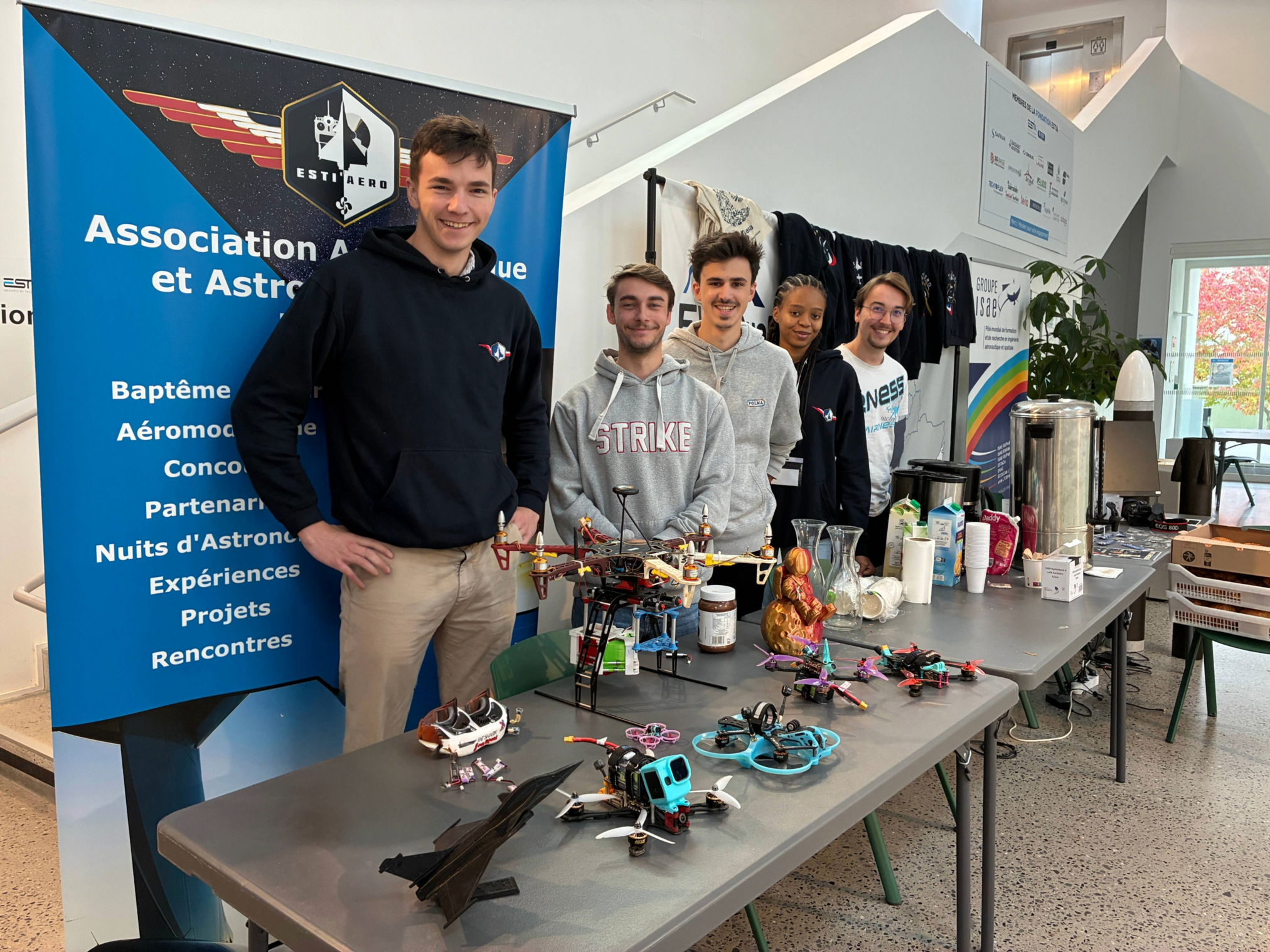
In a rapidly changing European context - marked by the development of Ariane 6, the boom in low-earth orbit satellites and the rise of private players - the aerospace sector is recruiting young engineers with a passion for aerospace, who have both an engineering degree and a mastery of advanced mathematical models.
At ESTIA, a general engineering school and member of the ISAE group, aerospace is at the heart of an innovation ecosystem, with direct links to aeronautics and space companies.
What is an aerospace engineer?
An aerospace engineer is a multi-skilled professional whose tasks cover the entire life cycle of aeronautical and space systems. Their responsibilities range from fundamental research to design engineering activities, development, production, testing, maintenance and even marketing. The job requires a thorough understanding of a wide range of scientific and technical disciplines, including fluid mechanics, thermodynamics, composite materials science, electronics, computing and automation.
Aerospace engineers work in a wide variety of fields. In civil aviation, they may work on the design of more fuel-efficient, quieter or safer airliners, as well as on landing gear and airframes. In the defence sector, they contribute to the development of military aircraft, drones and missile systems. Finally, the space sector offers unique opportunities, from the design of observation or communication satellites to the development of space launchers and interplanetary probes. Aerospace engineers are therefore key players in innovation, capable of meeting complex technological challenges to guarantee the performance and reliability of systems using cutting-edge technologies.
There are several specialities within this profession. Aerospace propulsion engineers focus on the design and optimisation of aircraft and rocket engines. Aerospace structures engineers are responsible for the strength and lightness of composite materials used in airframes and space structures. Space test engineers validate the performance of systems and sub-systems before they are put into service, based on precise specifications and rigorous test services. The day-to-day work of these professionals in the field is often split between the design offices, where they use advanced mathematical models and computer prototypes for the design and progress phases of projects, and the laboratories or production sites, where they supervise manufacturing and testing. They are constantly involved in innovative product design and mission analysis, crucial steps for the success of any aerospace project, demonstrating exceptional know-how.
Aerospace engineer: full description
His field of activity covers :
- Satellite design for scientific or commercial missions;
- Analysis of orbital trajectories;
- Aerospace propulsion;
- Aerospace structures (airframes, landing gear, launchers);
- Navigation systems;
- Test services and design-phase engineering.
You may work as :
- Aerospace propulsion engineer ;
- Aerospace structures engineer
- Space test engineer;
- Aeronautical engineer;
- Aviation engineer in civil aviation.
The engineering profession is based on :
- Fluid mechanics ;
- Composite materials;
- Computer prototypes;
- Fluency in English and foreign languages;
- Working in multidisciplinary teams.
A large part of their work consists of transforming a strategic need into a viable technical solution, while respecting a precise state of progress and extreme safety requirements.
Aeronautical engineer and space engineer: what are the differences?
Aeronautical engineers are often referred to asaerospace engineers. The main distinction lies in the field of application:
- Aeronautical engineers work on aircraft, drones and civil aviation.
- Space engineers work on launchers, satellites in space and orbital missions.
But aerospace engineering skills are largely cross-disciplinary: fluid mechanics, structural dynamics, mathematical modelling, on-board systems.
How much does an aerospace engineer earn?
The salary for an aerospace engineer depends on:
- Years of experience ;
- Sector (industry, research, commercial function, design office);
- Country (France, United States, Quebec, etc.);
- Level of responsibility.
Entry-level aerospace engineer salary
An entry-level aerospace engineer in France can expect to earn :
- 35,000 to 42,000 € gross per year
Or approximately €2,300 to €2,700 net per month.
The salary of an entry-level aerospace engineer increases rapidly with experience.
Aeronautical engineer, what is your net monthly salary?
With 5 to 10 years' experience, an aeronautical engineer can earn :
- 45,000 to €60,000 gross per year
- Or approximately €3,000 to €3,800 net per month.
Median salary by job centre and international comparisons
- The average salary in Quebec: often more than CAD 80,000 per year ;
- In the United States: aerospace engineers can earn in excess of $100,000 depending on their responsibilities.
An engineer's salary reflects the scarcity of skills and the strategic importance of the aerospace sector.
How do I become an aerospace engineer?
Studying aeronautics: the classic route
There are several routes to becoming an aerospace engineer:
- Scientific preparatory classes ;
- Engineering school;
- Integrated aerospace engineering preparatory course;
- University with a bachelor's degree in aerospace engineering.
The aim: to obtain a recognised engineering qualification, guaranteeing a high level of scientific expertise and high employability.
Aerospace engineering training: why choose ESTIA?
ESTIA, a general engineering school, enables students to specialise in aerospace while maintaining a global vision.
As a partner member of the ISAE group, ESTIA is part of the network of leading engineering schools in the sector.
Students benefit from :
- An international environment
- A high placement rate;
- Companies offering internships related to the sector;
- Close links with well-known aerospace companies in the Toulouse region and across Europe.
Interview with an aerospace engineer: the inspiring career of Steren Parra.
Among the young engineers trained at ESTIA, Steren Parra 's career is a perfect illustration of the dynamic nature of the sector.
Now a mission analysis engineer at Arianespace, he is contributing to the study of Ariane 6 orbits.
His career plan
His dream was to become an astrodynamicist in a space agency. His ambition was to simulate and study possible trajectories for space missions.
After taking an ATS preparatory class in Grenoble, he enrolled at ESTIA and then completed a double degree at Cranfield University in calculation methods for the aerospace industry. This was followed by an internship at CNES in Kourou, working on Ariane 6 tests.
His best memory?
Building an experimental rocket at C'Space and taking part in Act In Space, an international space hackathon.
His testimony confirms that a general engineering degree can open every door in the sector.
Aerospace engineering jobs and career opportunities
The aerospace sector recruits in :
- Large companies
- Innovative SMEs
- New Space start-ups;
- Space agencies.
Engineers can progress to :
- Responsibility for simple and then complex projects;
- Management of multi-disciplinary teams;
- Advanced technical expertise;
- Strategic sales positions.
Recent developments in the sector, marked by the proliferation of low-orbit satellites, are boosting demand.
Civil aerospace engineer and industrial engineer
Industrial aerospace engineers work in a wide range of sectors with direct or indirect links to space:
- Civil aviation
- Defence
- Space;
- Advanced technologies.
They may also work as civil aerospace engineers on international projects, particularly abroad, in the United States for example.
IPSA, universities and schools: what's the difference?
Some schools, such as IPSA, specialise in aeronautical engineering.
General engineering schools such as ESTIA offer a broader approach, with the possibility of adapting your career plan while retaining expertise in aerospace.
The working hours of an aerospace engineer
Working hours depend on :
- Design phases
- Launch campaigns;
- Project progress.
In critical periods, particularly before a launch, the intensity can be high.
Do all aerospace engineers work in space?
No. Contrary to popular belief, not all aerospace engineers work directly on satellites or launchers. The aerospace sector encompasses a wide range of engineering activities, in both space and aeronautics.
Many engineers work in civil aviation, where they are involved in the design of ever more efficient airframes, landing gear and navigation systems. Others specialise in on-board systems, which are essential for automatic piloting, safety and optimising aircraft performance.
Composite materials are also a strategic area: these cutting-edge technologies make it possible to lighten structures while improving their strength, a major challenge for both aircraft and space launchers. Finally, the drones and autonomous vehicles sector has recently seen very dynamic developments, opening up new prospects for young engineers.
The aerospace sector is therefore vast, interconnected and constantly evolving, offering opportunities both in the traditional aeronautics industry and in innovations linked to New Space and the mobility of the future.
Aerospace engineer: discover our podcast!
La Voix de l'Ingé - Episode 6: When engineers explore space
In this episode, we explore how engineers turn the dream of space into reality:
- How a space mission is designed ;
- The key role of the engineer in exploration;
- Inspiring stories from ESTIA.
With Steren Parra (Arianespace) and Franck Elain, ESTIA professor, involved in the development of the latest astronaut suit for Decathlon.
Listen to the episode: https: //linktr.ee/estiaofficiel
Conclusion: a forward-looking engineering profession
Becoming an aerospace engineer means choosing a demanding, strategic and meaningful profession. It means taking part in space exploration, technological innovation and major industrial developments.
By joining ESTIA, future engineers can build an ambitious professional project in an international environment, connected to cutting-edge companies and technologies.
The dream of space often begins with a childhood vocation.
It becomes reality thanks to engineers.