02 novembre 2026 - 06 novembre 2026
Application deadline : 26th October
Free event for all participants
Possible publication to MLS Health and Nutrition Research after the Young researcher school !
Abstracts will be presented to the MLS journal and may be selected to publish the entire article.
MLS Health and Nutrition Research
FR
La EU4Dual Young Researchers’ School on Health and Innovation est une semaine de formation intensive destinée aux jeunes chercheurs, universitaires et partenaires européens. Organisée à l’ESTIA du 2 au 6 novembre 2026, elle permettra d’explorer les enjeux liés à la santé, au bien-être et aux nouvelles technologies, notamment l’intelligence artificielle appliquée à la santé, à travers des conférences, des ateliers collaboratifs et des temps d’échange.
Inscrivez-vous dès maintenant pour y participer.
EN
The EU4Dual Young Researcher School on Health and Innovation is an intensive one-week training program for young researcher, academics, and European partners. Held at ESTIA from November 2 to 6, 2026, the program will explore topics related to health, well-being, and new technologies—particularly artificial intelligence applied to healthcare—through lectures, collaborative workshops, and discussion sessions.
Register now to participate.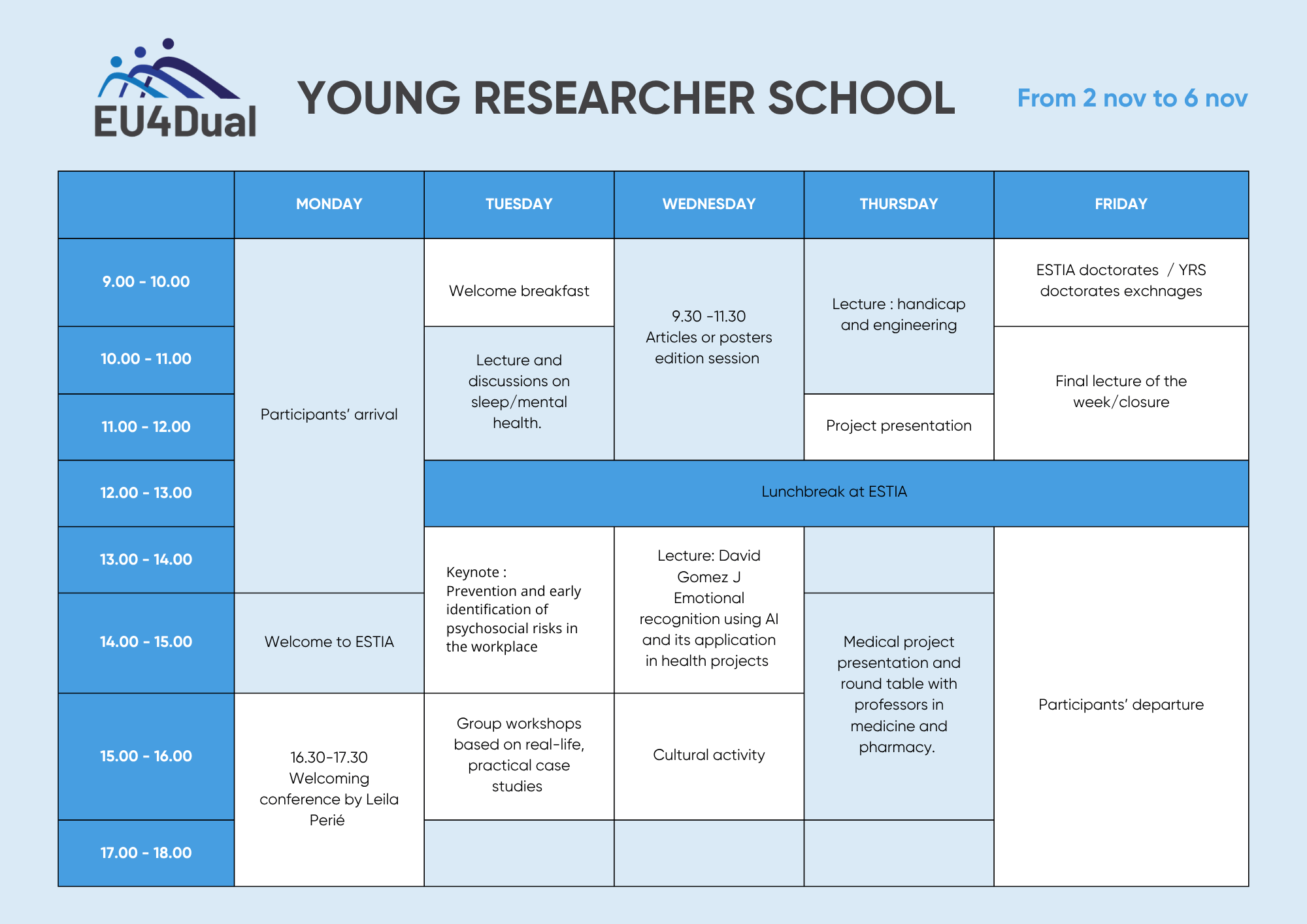
Monday 2nd Welcoming conference: General introduction on single cells and how they change biology and genetics approach, especially for cancer studies.
Speaker: Leila Périé, Ikerbasque Research Professor at Biogipuzkoa. Research line: Quantitative immuno-hematology
Tuesday 3rd: General lecture about sleep and its impact on health, work with a focus on industry.
Speaker: Maria Luojus (Savonia University of Applied sciences). Research line: Sleep disorders sleep medicine
Tuesday 3rd: Keynote about identification of psychosocial risks in the workplace. Work groups on actual study cases.
Speaker: Manuel Sobrino Garcia, PhD and engineer at Renault. Project Manager. Research line: Industrial Engineering, psychosocial risks at work and in industry.
Wednesday 4th: General lecture about AI and emotional recognition usign AI. Presentation of its projects : Prendre la parole.
David Gomez (ESTIA), assistant professor at computer sciences. Research line: Affective Computing, Human-Computer Interaction, Computer Vision, Artificial Intelligence, Virtual Reality.
Prendre la parole: This research project uses artificial intelligence to better interpret people’s current modes of expression, with the aim of supporting more intelligible and personalised communication. Beyond the technological feat, it embodies a strong vision of inclusion, self-determination and empowerment.
Thursday 5th: Lecture and demonstration about their research and exoskeletons, their application in medicine (disabilities) and in the workplace. Exoskeletons can be used for workers to ease loads especially in the industry.
Gogoa : company specialised in research around exoskeletons, robotics and disability.
Thursday 5th: Round tables around medical research in the Basque country medical environment with the hospitals of Bayonne, Cantabria, DEUSTO university of San Sebastian.
Sam and Idival : projects gathering hospitals and other medical actors to work around crossborder medical issues.
This week can be funded by an Erasmus+ grant, STT, as a mobility for traineeship. Only for non-French participants.