Recherche
The European NAIA project will create a shared technology space linking businesses, technology centres, universities and institutions with a view to pooling infrastructure, knowledge and talent.
- This initiative aims to strengthen the advanced electronics ecosystem within the Euroregion and to contribute to the development of new industrial capabilities in strategic fields such as semiconductors, smart manufacturing and advanced automation.
- The project, led by AGUILA Technology and involving the GAIA Cluster, ESTIA, the Basque Government (through the Department of Education and the Don Bosco training centre), as well as the Regional Education Authority for the Nouvelle-Aquitaine academic region, has a budget of nearly one million euros and is co-financed by the Interreg POCTEFA 2021–2027 programme.
8 September 2026. – The electronics industry faces major challenges linked to the green transition, digital transformation, the need to strengthen European technological autonomy, and the strains affecting global supply chains. It is against this backdrop that NAIA (New Approach to Cross-Border Innovation in Advanced and Sustainable Electronics – A new approach to cross-border innovation in advanced and sustainable electronics), a European project that aims to make cooperation between the Basque Country and Nouvelle-Aquitaine a driving force for innovation, to strengthen the industrial fabric and to create new opportunities for economic development.
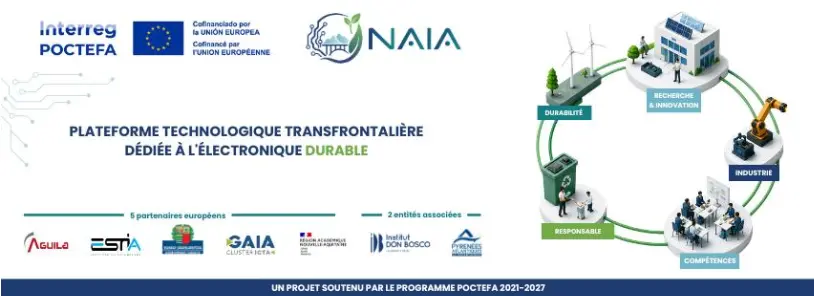
Supported by the Interreg POCTEFA 2021–2027 programme and co-funded by the European Union, NAIA will develop, over the next three years, the first cross-border technology platform specialising in sustainable electronics. This collaborative infrastructure will link the electronics ecosystems of the two regions, bringing together businesses, technology centres, universities, public authorities and training institutions to pool their expertise, develop joint projects and accelerate the transfer of knowledge to businesses.
The project is led by AGUILA Technology and brings together five major partners from the industrial, technological, educational and institutional sectors: the GAIA Cluster, ESTIA Institute of Technology, the Basque Government, through the Department of Education and Don Bosco, and the Regional Education Authority for the Nouvelle-Aquitaine academic region. Over the 36 months of the project, the consortium will work to consolidate this shared technology platform and, in doing so, strengthen the economic, industrial and technological integration of the cross-border area.
According to the information presented, this ‘Common Space’ will be structured around three major technological areas considered strategic for the future of industry:
- Breakthrough electronics, relating to microelectronics, chips and semiconductors.
- Cognitive manufacturing, based on advanced robotics and smart manufacturing processes.
- Connected intelligence, geared towards industrial automation and smart manufacturing.
Beyond providing easier access to technological infrastructure and equipment, the Common Space will enable businesses to discover the skills, products, services and projects available on both sides of the border, thereby fostering the creation of partnerships between businesses and knowledge centres that were previously difficult to identify. A company will, for example, be able to identify new technology partners more quickly, access complementary skills or identify opportunities for collaboration and innovation.
Furthermore, the NAIA project aims to:
- strengthen the region’s industrial and technological sovereignty by consolidating local capabilities in design, production, repair and recycling;
- promote the creation of new industrial activities and skilled jobs;
- accelerate the transition towards more sustainable electronics, based on the principles of the circular economy;
- facilitate technology transfer to businesses and support the transformation of SMEs through the development of new skills.
Training and talent to meet the needs of the industry
Another pillar of the project concerns talent development, a key challenge in meeting the growing demand for specialised profiles in the sector. NAIA will encourage joint training initiatives between the Basque Country and Nouvelle-Aquitaine, by promoting the organisation of specialised workshops, shared programmes, student exchanges and new initiatives designed to anticipate the skills the electronics industry will need in the coming years.
To this end, the project draws on a preliminary assessment carried out in both regions, which identified existing skills, available infrastructure and the key needs of the industrial and educational sectors. This information will serve as the basis for designing a new model of cross-border collaboration aimed at fostering innovation and growth in the sector.
Ultimately, the project aims to lay the foundations for a cross-border ecosystem capable of making the Euroregion a leading European region in the field of advanced and sustainable electronics.
Cristina Murillo, Deputy Director-General of the GAIA Cluster, emphasises that: “NAIA represents an opportunity to take collaboration between the Basque Country and Nouvelle-Aquitaine to a new level. Pooling infrastructure, knowledge and expertise will enable our businesses to access new opportunities for innovation, identify technology partners and accelerate the development of projects that would be much more difficult to carry out individually.”
Cristina Murillo also highlights one of the project’s key strengths: its ability to connect the knowledge already present on both sides of the border. “We want to build an ecosystem capable of creating new opportunities for our businesses, fostering industrial alliances and contributing to the development of strategic sectors such as advanced electronics and semiconductors. But we also want to train the talent that these industries will need in the coming years, by bringing together the skills and experience of the Basque Country and Nouvelle-Aquitaine,” she concludes.