
Formations
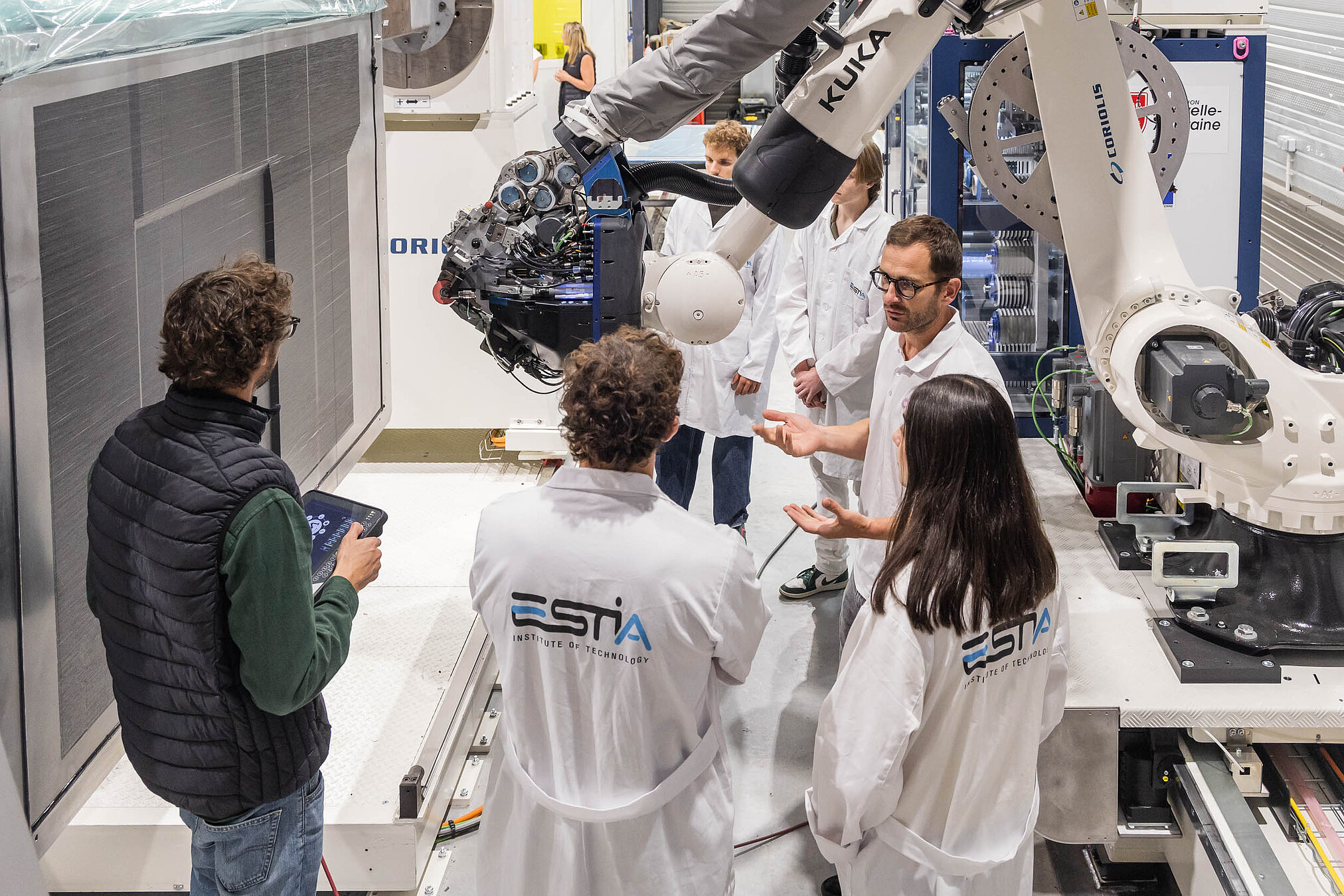
To become an industrial engineer, you generally need to complete a five-year engineering degree, combining science, technology, production management and project management. This course prepares students to design, organise and improve production systems in sectors as varied as aerospace, the automotive industry, energy and robotics.
At ESTIA, a general engineering school and member of the ISAE group, students acquire skills in mechanics, electronics, industrial computing, automation and industrial organisation. This multidisciplinary approach enables them to pursue a wide range of careers in industry, whilst developing their ability to innovate and work in an international context.
What is industrial engineering?
Industrial engineering encompasses the methods and technologies used to design, organise and optimise production activities. Its aim is to improve industrial performance by balancing quality, costs, lead times, safety and sustainable development.
Industrial engineers are involved throughout the entire production cycle, from product design through to manufacturing and distribution. They analyse existing processes, identify opportunities for improvement and support their implementation.
Their role lies at the intersection of several disciplines: mechanical engineering, electronics, industrial IT, automation, logistics and management.
What does an industrial engineer do?
The role of an industrial engineer involves improving the operation of production systems and managing technical or organisational projects.
Depending on their specific role, they may work in various areas:
- Industrial production: organising resources, monitoring key performance indicators and optimising manufacturing processes.
- Industrialisation: preparing new products for production and defining manufacturing methods.
- Industrial maintenance: improving the reliability of equipment and preventing breakdowns.
- Industrial performance: implementing continuous improvement and Lean management initiatives.
- Industrial project management: coordinating teams, industrial partners and the various stages of a project.
Industrial engineers must also support change management, particularly when integrating new technologies or transforming organisations.
What training is required to become an industrial engineer?
In France, an engineering degree is generally obtained after five years of higher education. It is awarded by an institution accredited by the Commission des titres d’ingénieur (CTI) and confers a Master’s degree.
There are several routes into an industrial engineering programme: after the baccalaureate at a school offering an integrated preparatory cycle, after a scientific preparatory class, or via parallel admission following a BUT, a bachelor’s degree or another suitable course of study.
The curriculum generally combines mathematics, mechanics, electronics, computer science, automation, production systems, industrial management and business management.
Some schools offer specialised programmes, whilst others favour a generalist approach, enabling engineering students to gradually shape their own academic path.
Why choose a general engineering programme at ESTIA?
ESTIA offers an international general engineering programme that combines fundamental sciences, mechanics, electronics, computer science, automation and industrial organisation.
This interdisciplinary approach enables students to understand industrial systems as a whole, from design to production, whilst developing their skills in project management and innovation.
During the engineering programme, students explore various disciplines in greater depth and may, in particular, specialise in the Industrial Organisation and Management track, which focuses on production management, quality, logistics and continuous improvement.
The programme also draws on projects, work placements and a strong international focus.
ESTIA is a member of the ISAE Group, a network of engineering schools recognised in the fields of aeronautics and space. This affiliation is part of an industrial and technological environment particularly conducive to multidisciplinary projects.
Is it possible to study for an industrial engineering degree through a work-study scheme or apprenticeship?
Yes, it is possible to study for a degree in industrial engineering through an apprenticeship. This pathway combines periods of study at the school with work experience in a company, under an apprenticeship contract.
The work-study programme allows students to put the scientific and technical skills acquired during their studies directly into practice.
It is particularly relevant to careers in production, maintenance, industrial IT, quality assurance and project management.
The structure of the work-study programme, admission requirements and specialisations vary from one institution to another. Applicants should therefore compare the course programmes, the emphasis placed on projects and the links with businesses.
Which specialisations should you choose in industrial engineering?
Industrial engineering covers a broad field of science and technology. The choice of specialisation depends on the sector targeted and the skills the student wishes to develop.
Industrial IT, electronics and automation
A degree in automation and industrial computing prepares students to design and operate automated systems. It draws on programming, industrial networks, robotics and monitoring tools.
The engineering programme in electronics and industrial computing focuses more on sensors, embedded systems and the interactions between hardware and software.
These skills are essential for the development of connected factories and Industry 4.0 technologies.
Production, maintenance and industrial performance
An industrial production engineering degree prepares students to manage manufacturing operations, organise resources and monitor quality.
Industrial maintenance focuses on equipment reliability, breakdown prevention and the optimisation of maintenance operations.
Industrial performance, meanwhile, combines continuous improvement, flow analysis, operational management and decision-making tools.
Industrial management and project management
A degree in industrial management develops the skills needed to coordinate teams, organise activities and support organisational change.
Industrial project management also involves planning, cost control, risk assessment and collaboration with industrial partners.
These skills are particularly sought after for leading complex projects in an international environment.
What are the career prospects for an industrial engineer?
There are numerous career opportunities for industrial engineering graduates. Graduates can work in the aerospace, automotive, energy, robotics, transport, logistics or consultancy sectors.
Potential roles include process engineer, industrialisation engineer, production engineer, maintenance engineer, quality engineer, supply chain manager or industrial project manager.
Digital and environmental transformations within industry are also creating new demands in areas such as robotics, digital twins, predictive maintenance and energy optimisation.
At ESTIA, the broad-based programme enables students to address these developments by combining several scientific disciplines. The school’s technology platforms, notably Compositadour, Addimadour and Turbolab, illustrate the links between research, innovation and industrial applications.
What is the salary of an industrial engineer?
An industrial engineer’s salary depends on their experience, specialisation, sector of activity and responsibilities.
According to APEC, 80 per cent of the gross annual salaries offered in the job vacancies analysed for industrialisation engineers range between 34,000 and 53,000 euros, with an average of 42,000 euros.
These figures relate specifically to industrialisation engineer roles and do not represent the full range of industrial engineering professions.
With experience, engineers can progress to roles such as production manager, industrial director or project manager.
How do you choose an industrial engineering school?
When choosing an industrial engineering course in France, several criteria should be considered: CTI accreditation, the curriculum, the specialisations on offer, work-study opportunities, work placements and international outlook.
The emphasis placed on projects and industrial technologies is also an important factor.
A broad-based programme may be particularly suitable for students who wish to keep their options open before choosing a specialisation.
At ESTIA, this approach is reflected in a curriculum combining engineering sciences, industrial technologies, project management and international experience.
Discover engineering careers with the ESTIA podcast
Industrial engineer, electronics engineer, mechanical engineer, computer engineer or energy engineer: there are many engineering professions, and their fields of application are constantly evolving.
To better understand this diversity, ESTIA presents ‘La voix de l’ingé’, a podcast dedicated to the various facets of the engineering profession.
Through interviews with professionals, the episodes explore specialisms, career paths and the practical applications of engineering, ranging from industry to artificial intelligence, via materials science, space and entrepreneurship.
A resource for prospective students who wish to discover the opportunities offered by an engineering degree and refine their career plans.
Train for careers in industry with ESTIA
Becoming an industrial engineer means preparing to design, improve and transform production systems whilst taking into account technological, economic and environmental challenges.
With its broad-based curriculum, international outlook, links with industry and membership of the ISAE group, ESTIA trains versatile engineers capable of working across a wide range of industrial sectors.
Sources
- APEC — Industrialisation Engineer
- APEC — Industrial Production Engineer
- Onisep — Industrial Maintenance Engineer
- Ministry of Higher Education — Engineering degree programmes
- Engineering Accreditation Commission
- ESTIA — International General Engineering Programme
- ISAE Group
- ESTIA — Engineers’ salaries in France
- ESTIA — La voix de l’ingé podcast