
Formations
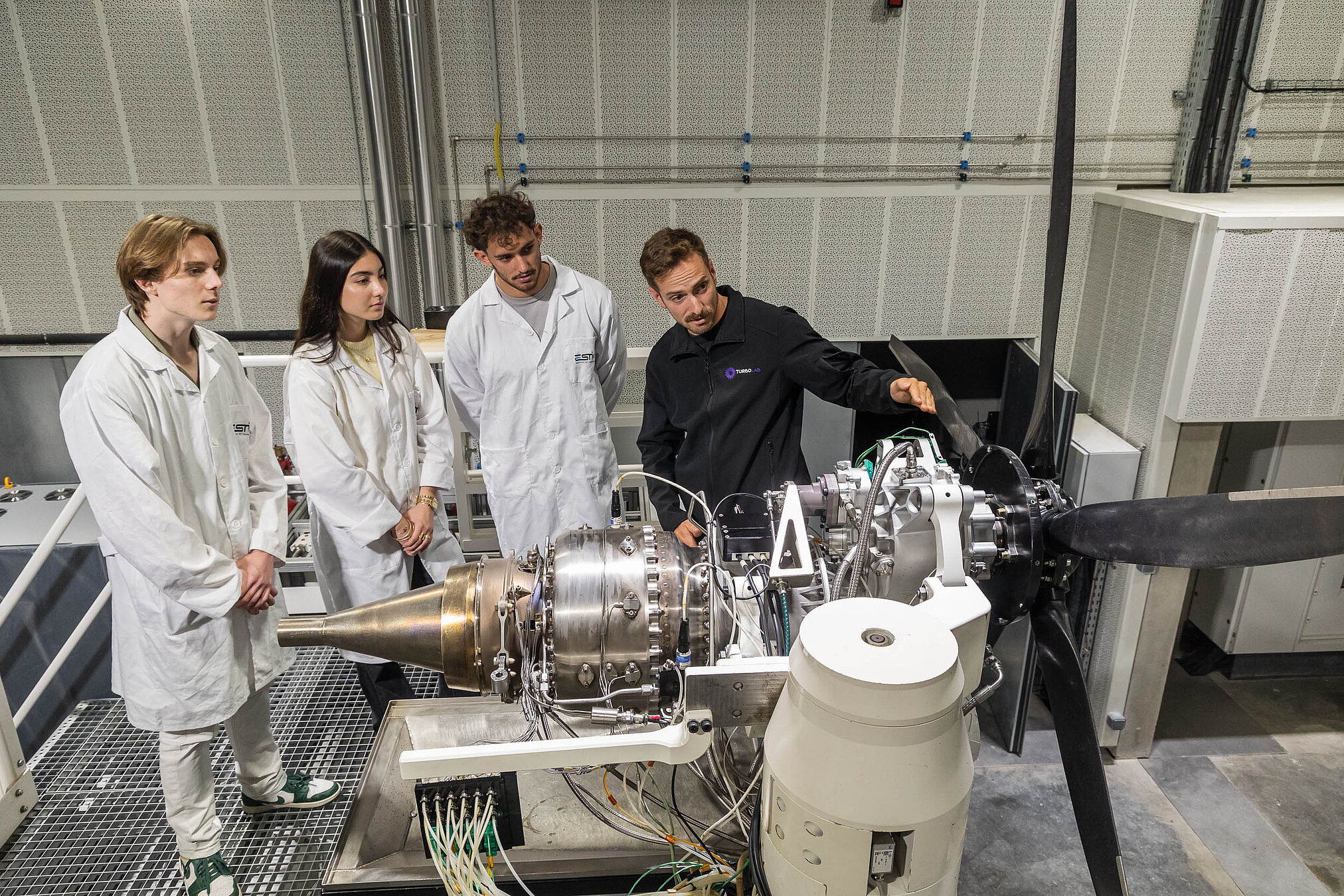
At ESTIA, this approach is reflected in a general engineering programme that combines mechanical engineering with electronics, energy and computer science. As a member of the ISAE Group and accredited by the Commission des titres d’ingénieur, the school prepares its students to thrive in a variety of industrial settings, from the automotive and aerospace sectors to production systems and the technologies of the industry of the future.
What does a mechanical engineer do?
The starting point is often a set of specifications. A client, a design consultancy or a company sets out a requirement: to make a structure lighter, to improve a machine’s reliability, to reduce its energy consumption or to design a piece of equipment that does not yet exist. The mechanical engineer then seeks a realistic solution – one that is sufficiently effective, manufacturable, safe and compatible with a given budget and timeframe.
In a design office, they may model a design using computer tools – often computer-aided design (CAD) software – select materials and check the strength of each component. Computer simulations make it possible to predict how a component or prototype will behave when subjected to stress, vibrations, heat or pressure. However, they do not always replace physical testing. A prototype may be manufactured, tested, improved and then tested again before a fully functional product is achieved.
The profession also has a very significant collaborative aspect. The engineer liaises with production, quality control, suppliers, and electronics or software specialists. They must ensure that a solution designed on screen can actually be mass-produced and remain reliable over time. It is this ability to bridge disciplines that often distinguishes a mechanical engineer from a specialist focused solely on calculations or technical drawing.
What is the role of a mechanical engineer depending on their position? Design engineer vs fluid mechanics engineer vs industrial mechanical engineer… what is the difference?
Day-to-day work varies greatly depending on the role held. A design engineer works primarily on defining a product or system. They analyse the requirements of the specifications, produce numerical models, select materials and verify that each component will fulfil its function. They then oversee the development of prototypes and refine the solution when tests reveal a weakness or a manufacturing difficulty.
The manufacturing engineer comes into the picture when the solution needs to move from the design office to the workshop. They work out how to produce the part under the right conditions, using the correct sequence of operations and the necessary resources. Their role involves, in particular, verifying that a product is suitable for mass production – that is, that it can be manufactured in series with a consistent level of quality and at a controlled cost. They often work with the production methods department, operators and equipment suppliers.
The production engineer, on the other hand, is more focused on the day-to-day running of a workshop or factory. They organise production systems, monitor the performance of the machinery and analyse deviations in quality, lead times or output. When a production line stops or a batch of parts is found to be faulty, they coordinate the investigation into the cause and the implementation of a solution. They may also be involved in continuous improvement, the modernisation of equipment and the reduction of energy consumption.
In a factory, the production engineer rarely works alone. They liaise with industrial maintenance to minimise downtime, with quality control to ensure product safety, and with logistics teams to guarantee the availability of components. This role gives them a very practical insight into how a company transforms raw materials into finished products.
Other engineers opt for a more scientific specialisation, such as fluid mechanics. They study the behaviour of air, water, gases or liquids within equipment. Their skills can be applied to improve a vehicle’s aerodynamics, size a hydraulic circuit, optimise a machine’s cooling system or analyse flow patterns within an energy system. Numerical simulations play a significant role, but testing and real-world application remain essential.
The industrial mechanical engineer operates at the crossroads of equipment design, manufacturing and performance. They may design a specialised machine, improve an automated production line, organise the maintenance of an industrial plant or support the integration of new technologies into a workshop. In the context of the industry of the future, they are increasingly working with sensors, production data and monitoring tools. Mechanics remains their foundation, but it is combined with automation, IT and mechatronics.
These roles are not strictly compartmentalised. A design engineer may move into industrialisation, a production engineer into site management, and a fluids specialist into research or technical consultancy. After a few years, many also become project managers. The technical aspect remains central, but it is now accompanied by organisational tasks, budget monitoring and team leadership. This diversity explains why an engineering degree is not based solely on scientific knowledge: it must also teach students how to communicate, make decisions and work with colleagues who do not all share the same expertise.
What does a mechanical engineer do?
Mechanical engineering refers to the field of knowledge that enables the design, manufacture and improvement of mechanical systems. It includes, in particular, strength of materials, fluid mechanics, thermodynamics, dynamics, manufacturing processes and industrial design.
In practice, a mechanical engineer uses this foundation to solve very practical problems. They may calculate the dimensions of a structure, analyse the cooling of a piece of equipment, improve the aerodynamics of a vehicle or optimise a production line. Mechanical engineering is therefore less a single profession than a foundation that opens the door to a range of sectors and roles.
At ESTIA, this foundation is integrated into a multidisciplinary course. The aim is to train engineers capable of understanding a system as a whole. A modern machine combines mechanical parts, sensors, actuators, electronics and software. The interplay between these fields is becoming particularly important in the context of mechatronics and Industry 4.0.
What qualifications are required to become a mechanical engineer?
To become a mechanical engineer, the standard route remains a five-year course following the A-levels, leading to an accredited engineering degree. There are two common routes: joining a science-focused preparatory class before entering an engineering school, or following an integrated course directly after the A-levels. Parallel admission is also possible after a BUT (Bachelor’s degree) in mechanical and production engineering, a science degree or another suitable technological qualification.
The level of maths and physics required is high, but it is not enough on its own to succeed. A good mechanical engineering programme must also expose students to projects, experiments and situations where multiple solutions are possible. It is often in these moments that one understands the difference between applying a formula and making an engineering decision.
ESTIA’s curriculum is designed with this in mind. The school offers a broad-based, international programme and emphasises learning by doing, through projects, work placements, work-study schemes and links with industry. Students develop an industrial understanding that enables them to tackle not only mechanical engineering but also energy, electronics and computer science. This versatility is useful for those who wish to keep several options open before choosing their specialism.
How do you become a mechanical engineer?
The process is similar to that required to become a mechanical engineer. You need to acquire a solid foundation in engineering sciences, then learn to apply this knowledge in an industrial context. Computer-aided design, simulations, materials, manufacturing processes and project management play a key role.
It is also useful to improve your English. In industrial companies, technical documentation, meetings and project teams are often international. At ESTIA, international outlook and language skills are integral to the very identity of the course.
Work-study programmes offer another way to progress. A student on a work-study engineering programme gains first-hand experience of how a department, its methods, a design office or a workshop operates. They learn to take into account production constraints, deadlines and a company’s working practices. This experience brings the course content to life and can make it easier to secure a first job.
How do you become an automotive mechanical engineer?
It is not necessary to undertake a separate course to become an automotive mechanical engineer. Most often, students begin with a general or specialised engineering degree, then shape their career path through an internship, a work-study programme or initial experience in the sector.
There are many possible areas of specialisation: chassis design, powertrains, braking systems, materials, manufacturing, quality assurance or vehicle electrification. The automotive sector is evolving rapidly, and mechanical skills are now combined with electronics, automation and software. Someone with the ability to understand these interactions can work on both conventional and electric vehicles.
Industrial projects undertaken during the course are particularly useful for gaining an insight into real-world work. At ESTIA, the multidisciplinary approach ensures that mechanics is not treated in isolation from other technologies. It helps students understand that a good system is not just a well-dimensioned component: it is a coherent, industrially viable and usable whole.
What are the specialisms and career prospects for a mechanical engineer?
Career opportunities for mechanical engineers are wide-ranging because almost all industrial sectors need to design, manufacture or maintain physical systems. An engineer may work in the automotive, aeronautics, space, energy, shipbuilding, capital goods, agri-food or engineering consultancy sectors.
Aerospace mechanical engineers work on structures, equipment or systems that must meet stringent safety and certification requirements. In the space sector, a space mechanical engineer must take into account launch vibrations, temperature fluctuations and the specific constraints of the vacuum. These environments demand rigour, but also the ability to work with specialists from a wide range of disciplines.
Fluid mechanics engineers, for their part, study the behaviour of liquids and gases. They may work on aerodynamics, hydraulics, ventilation, cooling or energy equipment. This specialism has applications in the automotive, aerospace, industrial and renewable energy sectors.
Other engineers specialise in mechanical engineering, industrial mechanics or building mechanics. In the latter case, their skills may relate to heating, ventilation and air-conditioning systems. The common thread running through these professions is the search for a solution that is reliable, efficient and suited to its intended use.
At ESTIA, being part of the ISAE Group provides a unique gateway to the aerospace and space sectors, without confining students to a single industry. The school trains generalist engineers capable of thriving in a variety of technological environments. This flexibility can be an asset in a climate where companies are looking for candidates capable of moving from one field to another.
What is the salary of a mechanical engineer?
In France, a mechanical engineer’s salary depends on their experience, the sector, the region, their level of responsibility and the size of the company. As a guide, a recent graduate can expect to start on a gross annual salary of around 35,000 to 40,000 euros. After several years, the salary is often around 45,000 to 55,000 euros, whilst experienced professionals, experts or project managers can earn over 60,000 euros gross per year.
These figures are merely indicative and do not constitute a guarantee linked to the qualification. A mechanical design engineer’s salary will vary depending on whether they work in a design office, for a manufacturer or at a consultancy firm. Similarly, the salary of an automotive mechanical engineer may vary depending on the manufacturer, the equipment supplier, the region and the technical complexity of the role.
Specialisms related to aeronautics, space, energy or complex systems may offer higher salaries, particularly when the engineer takes on project responsibilities or possesses sought-after expertise. International mobility can also significantly affect salary levels, but it is important to compare the cost of living, tax rates and working conditions, not just the advertised salary figure.
Which type of engineer is the best paid?
There is no single answer. The highest salaries are generally found in sectors where products are complex, constraints are severe and skills are rare. An experienced mechanical engineer in the aerospace, space, energy or automotive sectors may therefore be better paid than an entry-level engineer in another sector.
Salary also depends on the ability to take charge of an entire project. Knowing how to calculate or design is essential, but being able to explain a decision, negotiate with a supplier, manage a budget and lead a team progressively increases a candidate’s professional value.
What is the salary of a mechanical engineer in France, Germany or Switzerland?
Data published by Indeed provides a recent comparison between the three countries, provided the same criteria are used: these are average annual basic salaries associated with the job vacancies and self-reported figures recorded, and not net salaries after tax. In France, the average advertised salary for a mechanical engineer is €43,661 per year, with a range generally between €32,031 and €59,514; in Germany, the average is €69,938 per year, with a range of €50,284 to €97,274; in Switzerland, it stands at CHF 107,401 per year, ranging from CHF 70,157 to CHF 164,416. These figures, updated in September 2026, are, however, based on different data sets — approximately 1,100 salaries in France, 149 in Germany and 28 in Switzerland — and should not be interpreted as a direct equivalence in terms of purchasing power. The cost of living, social security contributions, employee benefits, the canton or region, and the level of responsibility can significantly affect the actual value of a salary. An engineer specialising in mechanical design, production or fluid mechanics may therefore earn a salary that differs significantly from this average, depending on their experience and the sector they work in. Specialisms related to aeronautics, space, energy or complex systems may offer higher salaries, particularly when the engineer takes on project responsibilities or possesses sought-after expertise. International mobility can also significantly affect salary levels, but it is important to compare the cost of living, tax rates and working conditions, not just the stated salary figure.
What should a mechanical engineer’s CV include?
A good CV for a mechanical engineer is not limited to a list of software programmes. It must demonstrate what the candidate has actually achieved. A design project, a working prototype, a process improvement or a work-study placement are more compelling when described in context and with their outcomes.
It is useful to specify the constraints encountered: weight to be reduced, strength requirements, cycle times to be improved, costs to be controlled or the number of parts to be produced. Proficiency in CAD, calculation tools or testing methods matters, but it becomes more meaningful when linked to a concrete achievement. Technical English, experience of working in a team and the ability to present a project are also valued.
ESTIA students can highlight the industrial projects, work placements and work-study schemes that punctuate their studies. These experiences demonstrate that they know how to move from theory to practice and that they understand how a business operates.
To find out more: listen to ESTIA’s ‘La Voix de l’Ingé’
A job description isn’t always enough to give a true picture of what a career is really like. That’s the whole point of the podcast *La Voix de l’Ingé*, produced by the teams at ESTIA. The episodes feature professionals who talk about their career paths, the choices they’ve made and the challenges they face in their day-to-day work. The episode ‘When the Engineer Brings Machines to Life’ is particularly interesting for gaining a different perspective on mechanical engineering. It features Simon Dabadie, an ESTIA graduate, designer and motorbike engineer, and Maxime Tolu, a mechanical engineer and head of Turbolab, the school’s aeronautical propulsion platform. Their discussion highlights the diversity of possible career paths: designing a motorbike, working on an aero-propulsion system or turning an idea into a prototype does not involve exactly the same tasks, but is driven by the same desire to solve real-world problems.
The podcast thus offers a better understanding of the various career paths within engineering, beyond the job titles. For a sixth-former, a student considering a change of direction, or anyone weighing up the options between design, manufacturing and mechatronics, these accounts can help them envisage their future more realistically.
Maxime Tolu is convinced: “Whether you work for a large company, an SME or a start-up, being a mechanical engineer is a fascinating profession. In my case, my main responsibilities vary from one project to the next. I have to come up with technical solutions, keep abreast of technological developments, help design and improve mechanical systems, and also support the prototyping and testing phases. You need to be able to quickly understand a problem, identify the constraints and propose a solution that is reliable, feasible and tailored to the project’s needs. What I particularly enjoy is this diversity: you can move from highly technical analysis to discussions with the teams, then return to the field to check that a prototype is working properly.”
Why choose ESTIA to become a mechanical engineer?
Choosing an engineering school isn’t just about comparing programmes. You need to look at the way you learn, the emphasis placed on industry links, the international outlook and the opportunity to gradually build your career path.
ESTIA stands out for its broad-based programme, which combines mechanical engineering with electronics, energy and computer science. Its location within the Izarbel technology park in Bidart places it within an ecosystem where education, research, technology platforms and businesses converge. Students can thus approach mechanics as a dynamic discipline, linked to industrial transformation and the challenges of sustainable development. Its membership of the ISAE Group is also a key draw for students interested in aeronautics, space and engineering sciences. This complements the school’s own identity: an international dimension, close links with industry and a teaching approach that places great emphasis on projects. Becoming a mechanical engineer ultimately means learning not only how to make things work, but also why they work and how to improve them. At ESTIA, this expertise is developed at the intersection of technology, industry and people. This, in turn, enables students to choose their specialism: design, manufacturing, automotive engineering, aeronautics, energy, mechatronics or project management.
References
Official presentation of ESTIA
ESTIA, a partner of the ISAE Group
Podcast: La Voix de l’Ingé – ESTIA
ESTIA’s International General Engineering Programme