
Formations | Vie du campus
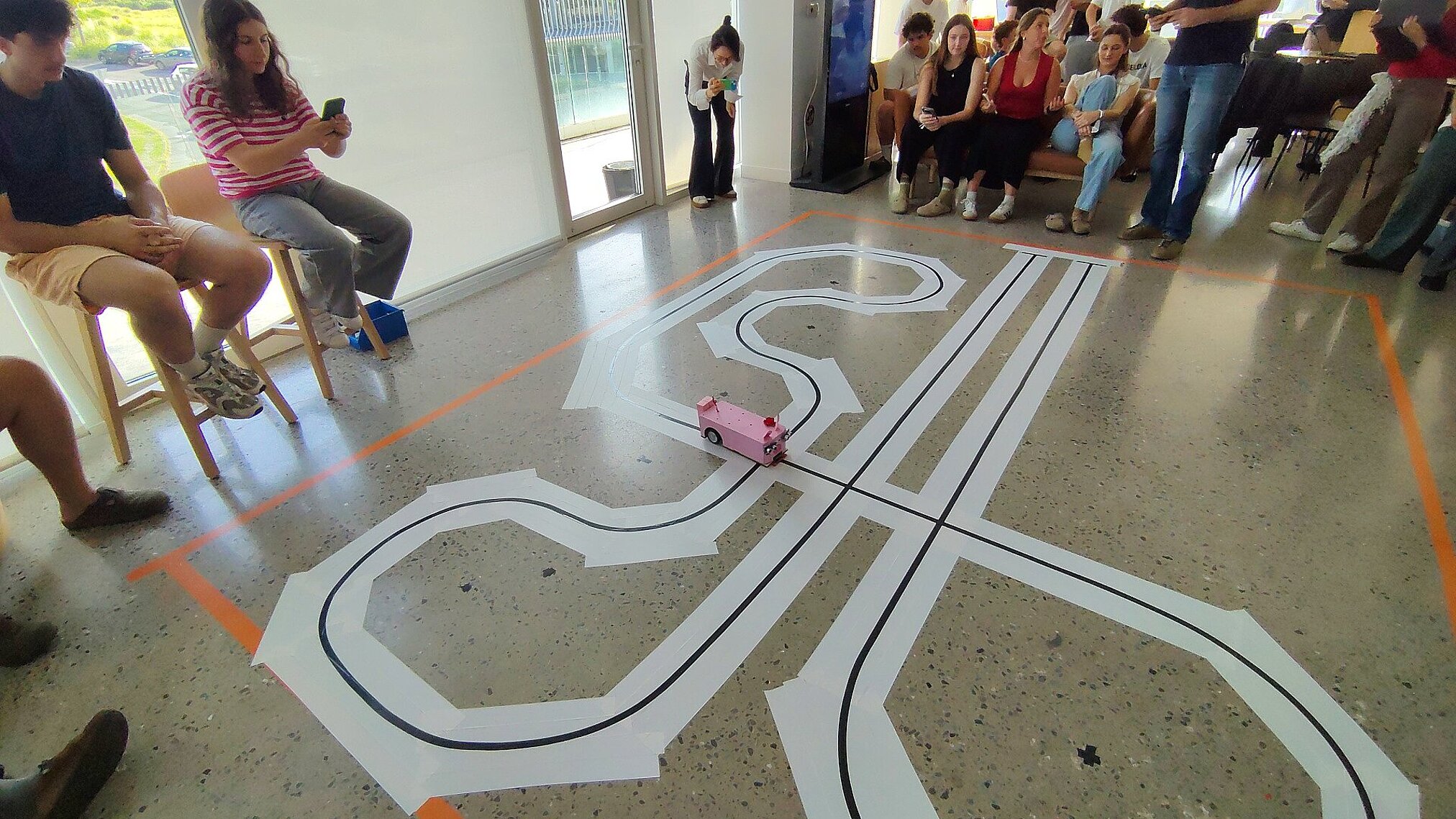
At ESTIA, supervised projects enable engineering students to tackle real-world problems at a very early stage, combining technology, teamwork and innovation. This year, students on the CPI 2A course (2nd-year Engineering Preparatory Cycle) took on a unique challenge: to design a remote-controlled car incorporating certain autonomous features, capable of following a route marked out on the ground.
A practical project for students on the ESTIA integrated preparatory course
The project began on 20 April at 8.30 am with 58 students divided into several teams. Over several weeks, they worked on the design, development and refinement of miniature vehicles capable of navigating a defined circuit.
Objective: to design a car that is both remote-controlled and partially autonomous, capable of following a route marked out on the floor of the CROUS using various on-board systems.
Through this supervised project, the students drew on a wide range of technical and interpersonal skills:
- electronics;
- mechanics;
- programming;
- automation;
- project management;
collaborative working.
An immersion in the engineering profession from the integrated foundation year
At ESTIA, project-based learning plays a central role in engineering education. From the very first years, students learn to turn an idea into a working prototype by going through different stages: finding solutions, design, testing, iterations and continuous improvement.
This project on the miniature autonomous car enabled them to discover the realities of technological development in conditions similar to those encountered in a company or laboratory.
Beyond the technical aspects, students also had to manage time constraints, coordinate tasks within their team and defend their choices during the final presentation.
A timed competition to round off the project
On Friday 22 May, the various teams presented their prototypes during a morning presentation session held on campus.
A particularly eagerly awaited moment: a timed competition to assess the vehicles’ performance on the defined course. Precision, stability, speed and the ability to follow the trajectory were put to the test in an atmosphere that was both studious and friendly.
This final presentation showcased the work carried out by the students throughout the project and highlighted their creativity and adaptability.
ESTIA’s integrated foundation year: learning engineering differently
With its integrated, international and trilingual foundation year, ESTIA offers an educational approach based on experimentation, openness and learning by doing.
Supervised projects play a key role in this approach. They enable students to develop practical skills whilst discovering the current challenges facing engineering and innovative technologies.
Through this type of challenge, future engineers learn to design, collaborate and innovate from the very first years of their training.